


FAQ
We answer your most frequently asked questions about our special needs equipment.
Rehatec offers standing frames, seating aids and mobility bases. You may combine all oft hem with individual headrests. Here are our three types of special needs equipment.
1 Standing: supine stander or upright stander
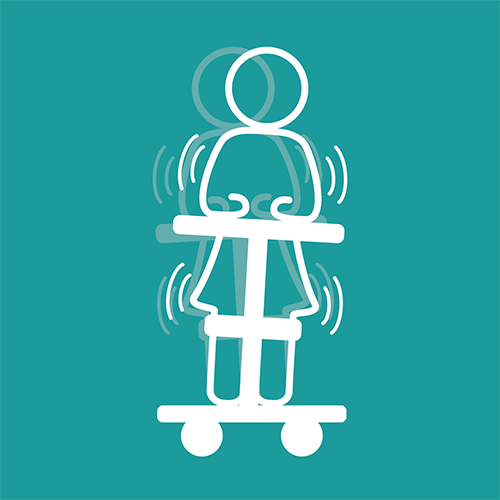
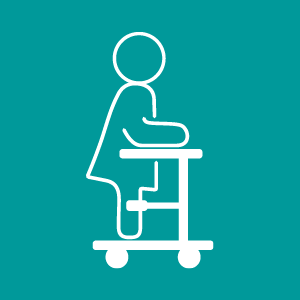
An upright stander helps people who are not able to stand upright on their own to get in an upright position. Our solutions for standing cover various fields of applications – standing in supine, static standing, dynamic standing and mobile standing.
1.1 Standing in supine
Our upright and supine standers Lasse and Da Vinci enable standing in supine. Caregivers put the stander in a horizontal position for a safe transfer of the user. Then they move the user gently and slowly to the very upright position meeting individual requirements, desirable therapy goals and the user’s physical well-being.
1.2 Static standing
We offer a broad variety of upright standers for static standing. Your choice depends on age and requirements. Small children train classic standing in the upright stander Jumbo; older children, teenagers and adults use the upright stander Standard. Jumbo for knee-ankle-foot orthoses is the perfect solution for children using this kind of orthoses. As soon as you need active support to put a user in an upright position, we recommend the upright stander Impuls providing an integrated electric standing aid.
1.3 Dynamic Standing
In addition to the option of static standing, the upright stander Benni also offers the possibility of training balance and equilibrium. The centre column is dynamic and can be adjusted as desired so that it trains dynamic standing against gravity.
1.4 Mobile standing
Our upright stander Speeedy allows you to be mobile during standing training thanks to large wheels. Users can move around in an upright position.
2 Seating: activity chair or hi-lo base
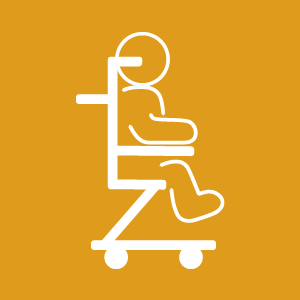
People with physical disabilities usually cannot sit in a normal chair. They need either a seating position tailored to them or even a seat shell made for them. For this reason, we offer you two different types of special needs equipment in the field of seating:
2.1 Activity chairs
Our Nele activity chair is primarily aimed at toddlers and children up to the transition to teenage years. They are essential for participation in inclusive kindergartens as well as for a joint everyday family life, as the child can participate in many activities while seated. Thanks to numerous adjustments and a wide range of accessories, the child is perfectly secured and has an adapted, comfortable sitting position. The chair also adapts to different table heights.
2.2 Hi-lo bases
Rehatec hi-lo bases are intended for people who need a seat shell individually adapted to them for sitting. This seat shell is placed on the frame, i.e. on our hi-lo base. As a rule, the seat shell is made and placed on a Rehatec hi-lo base by thh staff of a medical supply store. They know your needs and requirements and can adapt the frame and the seat shell to each other.
3 Moving: mobility bases
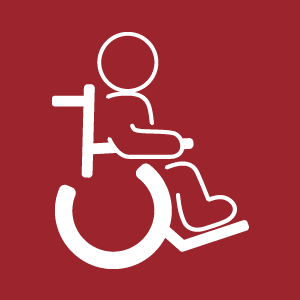
Everyone knows the classic wheelchair, which people with disabilities can use to move around. However, these so-called active wheelchairs are not part of our programme. We offer you seat shell chassis that form the undercarriage of a wheelchair, so to speak.
Our products in the field of movingare primarily aimed at severely disabled people, from children to teenagers and adults to senior citizens. These people are not able to move themselves in this mobility base, or are only able to do so for a short time and with restrictions. They usually have to be pushed.
These users usually need an individually adapted seat shell to sit. As a rule, the seat shell is made and placed on a Rehatec mobility base by the staff of a medical supply store. They know your needs and requirements and can therefore select the perfect mobility base for your seat shell and adapt both to each other.
For parents and patients
If you as a parent or patient are interested in Rehatec special needs equipment, please contant us and we will inform you about any Rehatec partners in your country - specialist dealers who can give you the best advice.
Ideally, the specialist dealer has a showroom to present all kinds of special needs equipment. In this case, you can look at the devides directly on site and test if necessary. If not, you are welcome to express your wish for a Rehatec device. The responsible specialist dealer will then contact Rehatec and, if possible, arrange the respective device.
Unfortunately, you as a parent or patient cannot request any kind of special needs equipment directly through us. You always need a Rehatec partner or at least a medical supply shop, which you either contact directly or which works together with your institution and is therefore part of the process.
For dealers, medical supply stores, facilities, therapists, etc.
If you are interested in our special needs equipment, our brochures will offer you an overview. Select Downloads to either download our entire product overview or find product flyers in the respective categories.
If you would like to have a print version of our brochures, use our contact form or send an email to info@rehatec.com.
For parents and patients
Rehatec offers you the opportunity to test products. In our opinion, testing is indispensable for a good and needs-based supply of special needs equipment. You express your wishes at the medical supply store supporting you. The staff member responsible for you will contact us and we will find a solution tailored to your needs and wishes. By the way, there is no set duration for trials at Rehatec. We focus on your situation and work with you to find the best approach and trial period for you.
For dealers, medical supply stores, facilities, therapists, etc.
We are also happy to provide you with equipment for exhibitions, trials and the like on request. There is also the possibility to get a device permanently for your showroom. For example, we supply our special needs equipment to facilities where it is then regularly used by patients and therapists. You can also receive our equipment temporarily as demo devices.
For each Rehatec products you will find a colour overview with frame colours and, if available, cover colours on the corresponding product page. We offer these colours as standard.
However, if you have a specific colour that we do not currently list, you are welcome to ask us for it. We will check its availability and make you an appropriate offer. In the past, for example, we have designed devices in football club colours. Custom colours, if available, are always possible, but subject to an additional charge.
|
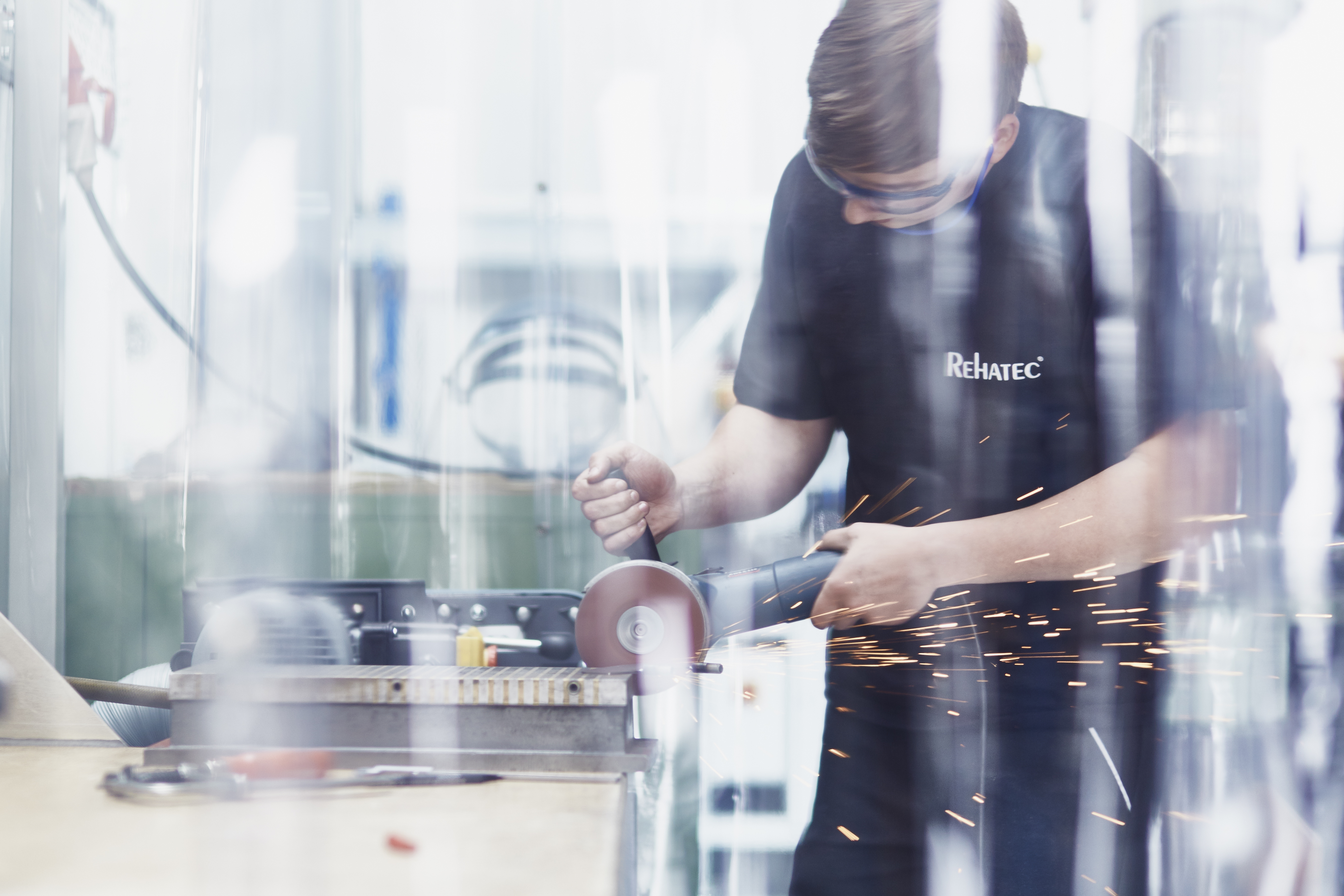
All Rehatec products are manufactured exclusively in our factory in Schönau in the Odenwald, from the idea to the finished product. We have our own development department and even manufacture some parts, e.g. our frames, in our large metalworking shop. The departments for upright and supine standers, upright standers, activity chairs and mobility bases produce and adapt the respective devices. Special requests are fulfilled in individual manual work by our customisation department. And packaging and shipping also take place in the idyllic Odenwald. All materials and those parts that we do not manufacture ourselves are sourced from global suppliers. However, a large proportion of these come from companies based locally or throughout Germany. A neighbouring carpenter's workshop, for example, manufactures our wooden parts. Our therapy tables, armrests, footboards etc. are carefully made from FSC-certified wood and veneer. A German tailor shop always supplies us with your covers and straps in a precise and reliable fit, and a German company is also responsible for the many colourful frames. |
 |
We cannot give a blanket delivery time for all products, as our special needs equipment is very different and production additionally varies in complexity depending on the configuration. However, you will receive an estimated delivery date for your order and can check the status of your order at any time by contacting our head office.
|
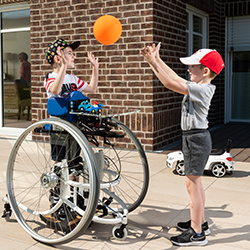
A child's ability to stand is an important developmental step for the body's own locomotion. At any age, experience proves that standing has a positive effect on the human organism. Standing strengthens muscle tone, increases bone strength, stimulates blood circulation and improves skin structure by avoiding pressure points. The patient trains muscles and thus stabilises the entire body, promotes the digestive and cardiovascular systems, trains balance and improves breathing. At the same time, the susceptibility to cramps is lower when standing and the ability to concentrate as well as self-confidence increase in an upright position. Standing is a complex process that requires a high level of coordination from the brain. This process controls various muscle groups in a specific sequence and ensures that these groups tense up. A secure standing position is a prerequisite for the statomotor development of the body into stable, coordinated locomotion on two legs. This applies both to small children who are just learning these skills, but also to any patients who have lost this ability. |
 |
There are a variety of diseases and disabilities for which the use of a standing frame is recommended. Among them are
- (infantile) cerebral palsy (ICP or CP)
- muscular dystrophy (e.g. Duchenne muscular dystrophy; Floppy infant)
- syndrome diseases
- central and peripheral paralysis (e.g. paraplegia, craniocerebral injury)
- Hemiplegia
- global developmental delays
- progressive neuromuscular diseases (e.g. amyotrophic lateral sclerosis, multiple sclerosis)
- Tetraplegias
- Paraplegias
- persistent vegetative state
- Lou Gehrig's disease and disseminated sclerosis
- Age atrophy
- postoperative problems (corrective osteotomy)
|
The therapeutic benefits for all forms of disability can be divided into physical and psychological aspects. If you look at the patient's body, a standing device puts an axial load on the hip joints and bony structures. Standing prevents contractures and prevents osteoporosis. In addition, standing therapy activates the leg muscles, stabilises the trunk muscles and promotes the patient's head control. A possible change in position provides pressure relief. The upright position stimulates the cardiovascular system and improves vital functions. Patients also benefit psychologically from standing. An upright posture makes it easier to actively participate in everyday life and also facilitates the communication with relatives. It has been proven that standing also has a positive effect on the ability to speak. Standing upright makes it easier for the patient to be attentive and concentrated, so that playful or more demanding activities are also possible and cognitive development is promoted. At the same time, the patient feels "equal" to his environment at eye level and thus increases his self-confidence. |
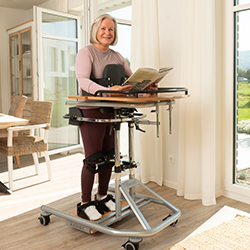 |
Rehatec standing devices can be divided into three categories:
- Standing frames that are able to put patients in an upright position. These devices are called upright and supine standerst: Heidelberg Supine and Upright Stander Lasse or Biometric Standing System Da Vinci
- Standing frames into which patients are transferred already standing. They are called upright standers: Heidelberg Upright Stander Standard, Heidelberg Upright Stander Impuls, Heidelberg Upright Stander Jumbo or Jumbo for Knee-ankle-foot Orthoses, Heidelberg Upright Stander Benni
- Standing frames enabling patients to move around on their own: Heidelberg Upright Stander Speeedy
For more passive or hypotonic patients, as well as for patients with existing contractures, standing frames moving patients from a supine to an upright position are particularly suitable (1). These standers make transfers easier and safer for patients and their relatives or caregivers.
A patient who has residual muscular stability in the trunk or who can still assist when being put in an upright position is better served with a vertical standing device (2). For training purposes, the inclination can be adjusted to the front (multi base frame).
For patients who can also use their arms, standing devices enabling them to move around independently are possible (3). Our Speeedy has large drive wheels attached to the side, with which the patient can drive on his/her own.
|
Most people spend most of the day in different sitting positions and perceive or interact with their environment in this position. If you look at a toddler, sitting is part of the second important developmental step. In contrast to the lying position, sitting allows the patient an upright level of perception. With some mobility of the head and upper body, an all-round view of up to 360 degrees is possible. Sitting upright on their own, patients can act more autonomously and independently. At the table they can eat or drink by themselves or occupy themselves, e.g. read, look at books, do puzzles, handicrafts or paint. |
 |
There are a variety of diseases and disabilities for which the use of an activity chair or a hi-lo frame is recommended. Among them are
- (infantile) cerebral palsy (ICP or CP)
- muscular dystrophy (e.g. Duchenne muscular dystrophy; Floppy infant)
- syndrome diseases
- central and peripheral paralysis (e.g. paraplegia, craniocerebral injury)
- Hemiplegia
- global developmental delays
- progressive neuromuscular diseases (e.g. amyotrophic lateral sclerosis, multiple sclerosis)
|
Even a person without limitations needs to practise this posture and be stabilised. If a child is not physically able to sit and hold the position independently, you should still initiate this step in line with an age-appropriate development of statomotor skills. In order to (re)establish a patient's sitting ability, it is important to consider the patient's individual posture in order to provide optimal support. The degree and type of sitting restriction is decisive for the necessary support. Sitting offers the following advantages in everyday life, which therapeutically contribute to a strengthening of self-confidence as well as a better ability to communicate and concentrate. Sitting leads to statomotor independence (the ability to pursue activities alone without being held). Sitting is the basic prerequisite for mobility. Travel in a pram or wheelchair, car journeys and many other ways to move around are often only possible in a sitting position. In einer stabilen Sitzposition sind die Arme von Patienten frei beweglich, womit neue Freizeitaktivitäten möglich sind. In a stable sitting position, patients' arms are free to move, enabling new leisure activities. In the case of young children, sitting is the first step towards independence in everyday life, as the child is separated from the parental arm or lap. |
 |
Depending on the clinical picture and/or degree of disability, a seating aid must meet different requirements, including a hyperactive or hypotonic movement pattern, spasticity and the like. It is important to be able to adjust the seating aid to the individual posture and build. And especially with children, it is advisable to pay attention to an seating aid that grows with them piece by piece, so that the little ones also benefit from it for as long as possible.
Activity chairs are available with different bases. There are bases that are mainly designed for indoor use and bases with special wheels that can be used both indoors and outdoors.
There are also various technical options to adjust or a seating aid for therapeutic seating. Possible accessories and necessary options are:
- n order to optimally accommodate the individual hip position, the seat should be adjustable in its entire inclination and an angle-adjustable back is recommended.
- The activity chair or hi-lo base should be adjustable to different table heights or height-adjustable for different activities.
- Support to the side for the upper body must be provided by adjustable support elements, e.g. chest supports.
- To ensure that the patient's head remains stable and does not tilt forward or to the side when the patient has no head control, adjustable headrests in different shapes are very important. They meet individual requirements and offer maximum safety with accessories such as chin prompts or headbands.
- Dorsal supports, an table to rest one's arms on and arm rests help the patient to position their arms, rest them and actively pursue various activities.
- An adjustable lateral and medial leg positioning accommodates the shape and possible contractures of the legs, avoids pressure points and ensures a comfortable fit.
- Optimal seating also considers the position of the patient's feet. Footrests are symmetrical or asymmetrical and are adjusted in height and inclination.
- Parents or caregivers use harnesses to secure the patient's pelvis, upper body and ankles so that the patient is stable and secure, even without immediate supervision.
|
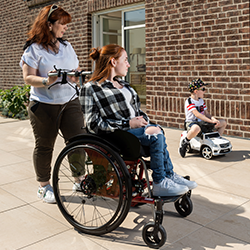
From a therapeutic point of view, it is important that the mobility base meets the individual requirements of the patient and his or her clinical picture. It is the technical aspects of a undercarriage that determine whether there is a therapeutic benefit:
|
 |
|
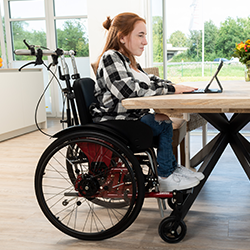
People who are unable to walk independently need an active wheelchair or a mobility base. An active wheelchair is designed for people who can move independently in a wheelchair with the help of their arms. Mobility bases are intended for people with major disabilities who need to be pushed by a caregiver. They are not able to move or steer a wheelchair under their own power or drive. For patients who can use their arms minimally, the Galileo mobility base is an intermediate solution. Due to the possibility of changing the wheel position horizontally, the undercarriage can also be used by users who have limited ability to move independently. Users who can propel a wheelchair minimally with their arms, e.g. to move around a room or the corridor of an institute, are also well served by a Galileo. |
 |
From a therapeutic point of view, it is important that an mobility base meets the individual needs of a patient. In this case, it is the technical details that make a difference. Here are some examples:
Is it possible to tilt the underframe, what is the maximum recline and can you adjust it yourself?If it is possible to tilt the seat shell on the undercarriage, you get a relieving sitting position due to the effect of gravity. Especially in hypotonic forms of disability with weak body tension, it is often necessary to tilt the seat as far back as possible. Can ypiu adjust the push bar together with the back to fit the seat shell?
In case you can tilt the push handle together with the back steplessly backwards, this influences the degree of the patient's hip joint angle. A tilted back provides additional relief. A smaller angle, on the other hand, inhibits e.g. a strong extension tone of the patient. Is the seat plate height-adjustable?
Provided that the height of the seat plate is variable, caregivers achieve a necessary transfer height. A higher seat plate also creates more space for necessary medical equipment, such as medication pumps or ventilators. In this case, we recommend combining it with a medical platform. Does the mobility base have an abduction or a normal frame?
An abduction frame offers more space in transfer situations. But the legs are also abducted for therapeutic purposes, e.g. for functional positioning. Therapists place the femoral heads in the acetabular cups or treat patients post-operatively. Does the frame length fit your requirements and can the seat depth be adjusted?
Wide-open seat shells in particular require an increased degree of stability. You can achieve this with an adapted seat depth. A significantly longer frame extends the wheelbase and can be realised at Rehatec, e.g. as customisation. Can the mobility base grow with the child?
For younger patients who are still growing, an undercarriage with built-in growth options is recommended so that they can benefit from a mobility base for as long as possible.